
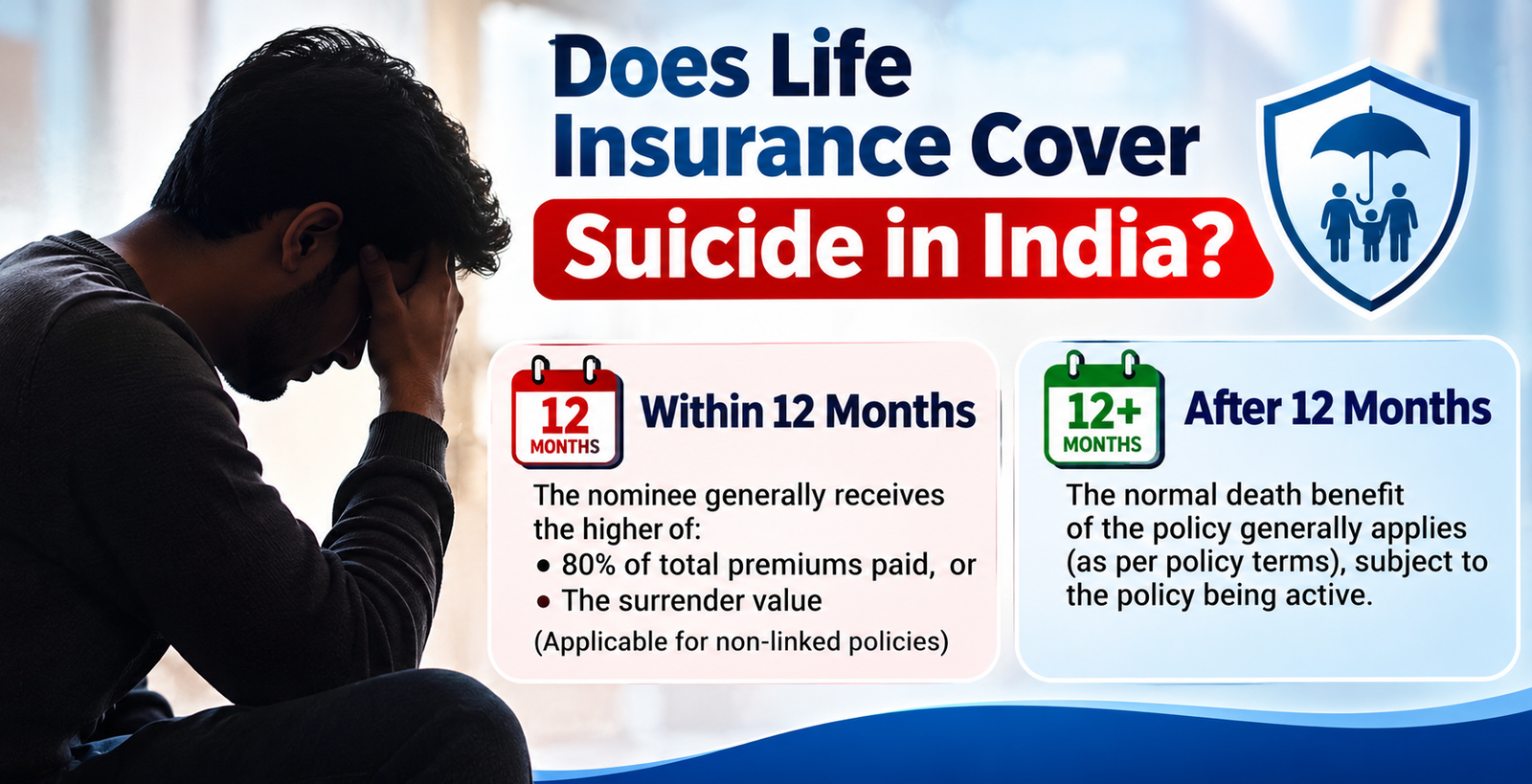
One common question people have about life insurance is: Does life insurance cover suicide in India? The answer depends on the policy type, the date the insurance risk commenced, whether the policy was revived and the terms and conditions of the insurance contract.
In India, life insurance policies generally have a specific 12-month suicide exclusion provision. However, this does not mean that the nominee receives nothing if death occurs during this period. IRDAI’s applicable provisions specify certain benefits payable to the nominee or beneficiary, depending on the type of policy.
Understanding this rule is important for policyholders and nominees because the claim amount during the first 12 months can be very different from the normal death benefit payable after that period.
For non-linked life insurance products, the applicable IRDAI provision generally provides at least 80% of total premiums paid or the surrender value, whichever is higher, for an eligible suicide claim within the specified 12-month period, provided the policy is in force. ULIPs follow a different fund-value-based rule.
Does Life Insurance Cover Suicide in India?
Yes, life insurance can provide a death benefit following suicide, but the amount payable depends on when the death occurs and the applicable policy conditions.
The important distinction is between:
- Suicide within 12 months: A special suicide clause applies. The benefit is determined according to the applicable policy category and IRDAI provisions.
- Suicide after 12 months: The normal contractual death benefit generally becomes applicable, subject to the policy being valid and other claim conditions being satisfied.
The 12-month period is generally calculated from the commencement of risk under the policy or from the date of revival, as applicable. It is not always simply 12 months from the date the policy document was issued.
1. If Suicide Occurs Within 12 Months (1 Year)
If death occurs due to suicide within 12 months from the commencement of risk under a non-linked life insurance policy, the special suicide provision applies.
According to IRDAI’s Master Circular on Life Insurance Products dated 12 June 2024, the nominee or beneficiary is entitled to at least:
Applicable Suicide Claim Benefit
Higher of:
- 80% of the total premiums paid up to the date of death, or
- The surrender value available on the date of death.
This applies to eligible non-linked policies when the policy is in force, subject to applicable product provisions.
This means the nominee may receive an amount even when the normal Sum Assured on Death is not payable under the suicide clause.
The amount is calculated according to the applicable policy provisions. It should not be assumed that the nominee will automatically receive the complete Sum Assured during the first year.
What Happens in a ULIP?
Unit Linked Insurance Plans (ULIPs) have a separate suicide provision. If death due to suicide occurs within 12 months from commencement of the policy or its revival, the nominee or beneficiary is entitled to the fund value available on the date of intimation of death.
Any charges other than Fund Management Charges (FMC) and guarantee charges recovered after the date of death are added back to the fund value, according to the IRDAI provision.
2. If Suicide Occurs After 12 Months (1 Year)
If death due to suicide occurs after the applicable 12-month period has expired, the special initial suicide provision generally no longer applies.
The nominee or beneficiary can become eligible for the normal death benefit under the insurance policy, provided the policy is valid and the claim is admissible under its terms and applicable law.
The amount payable depends on the type of life insurance policy:
- Term Insurance: The contractual Sum Assured on Death is generally payable according to the policy terms.
- Endowment Plan: The applicable death benefit may include Sum Assured on Death and accrued bonuses or other benefits, where available under the policy.
- Whole Life Insurance: The death benefit is determined by the contractual benefits of the particular whole-life policy.
- ULIP: The standard death benefit is calculated according to the policy’s death-benefit formula, which may depend on Sum Assured, fund value and other applicable adjustments.
Important: Do not assume that every policy automatically pays the full Sum Assured as a lump sum. IRDAI permits death benefits to be paid in a lump sum or instalments according to the policy contract. The exact benefit must be checked in the policy document.
3. Suicide Within 12 Months of Policy Revival
This is an important condition that many policyholders may overlook.
Suppose a person purchases a life insurance policy, pays premiums for some time and later stops paying them. The policy may lapse or become discontinued, depending on the product and premium-payment history.
If the insurer subsequently approves the revival of the policy, a new 12-month suicide exclusion period may apply from the date of revival.
The policyholder stops paying premiums and the policy is later revived on 1 July 2026.
For the purpose of the applicable suicide provision, the relevant 12-month period may now run from the revival date, subject to the policy terms.
Therefore, the original policy commencement date alone should not be used to determine the applicable suicide clause after a revival. Always check the revival endorsement and updated policy schedule.
4. Suicide Clause: Term Insurance vs Endowment vs ULIP
Different life insurance products have different benefit structures. The following table provides a general overview of how the suicide provision is treated.
| Policy Type | Within 12 Months | After 12 Months |
|---|---|---|
| Term Insurance | Special non-linked suicide provision applies, subject to the policy being in force. | Normal contractual death benefit generally applies, subject to policy terms. |
| Endowment Policy | At least 80% of total premiums paid or surrender value, whichever is higher, under the applicable non-linked provision. | Contractual death benefit, including applicable accrued bonuses where eligible. |
| Whole Life Policy | The applicable non-linked or linked suicide provision depends on the product structure. | Normal death benefit according to the policy contract. |
| ULIP | Fund value as on the date of intimation of death, with specified post-death charges added back. | Normal ULIP death benefit formula under the policy. |
This is a general comparison. Product-specific exclusions, revival rules, paid-up status and death-benefit calculations can affect the actual claim.
5. Does the Nominee Receive the Full Sum Assured?
This is one of the most frequently asked questions regarding suicide-related life insurance claims.
The answer depends on when the death occurs and the type of policy.
Within the applicable first 12 months: The special suicide provision applies. A non-linked policy generally provides at least 80% of total premiums paid or surrender value, whichever is higher, if the policy is in force. A ULIP follows its fund-value-based suicide provision.
After the applicable 12 months: The contractual death benefit generally applies. For example, a term insurance policy may pay its Sum Assured on Death, while a participating endowment policy may also include accrued bonuses.
The payment method can be a lump sum or instalments, depending on the contract and settlement option selected.
6. Does an Active Life Insurance Policy Matter?
Yes. The policy status is important when determining whether a death claim is payable.
For the non-linked suicide provision during the initial 12 months, IRDAI specifies that the policy must be in force.
Policyholders should therefore pay attention to:
- Regular premium payment dates.
- Applicable grace-period provisions.
- Policy lapse or discontinuance status.
- Revival approval and its effective date.
- Any reduced paid-up benefits available under the contract.
A policy that has lapsed and has no payable paid-up benefit may have a different outcome. The applicable policy wording must be examined before determining the nominee’s entitlement.
7. Can an Insurance Company Reject a Suicide Claim?
Suicide-related claims are assessed according to the insurance contract, the applicable suicide provision and the relevant legal requirements.
An insurer may examine matters such as:
- Whether the policy was active or had a valid paid-up value.
- The date of commencement of risk.
- Whether the policy had been revived.
- The date of death in relation to the applicable 12-month period.
- The policy type and its suicide clause.
- Whether the claim documentation is complete.
- Whether any relevant fraud or material misrepresentation issue arises under Section 45 of the Insurance Act, 1938.
It is important to distinguish the suicide exclusion period from the legal provisions regarding fraud or material misstatement. Section 45 contains separate rules governing when a life insurance policy can be questioned by an insurer.
An insurer’s decision should be based on the policy wording and applicable law, not merely on the fact that the cause of death was suicide.
8. Documents Required for a Life Insurance Death Claim
The nominee or beneficiary generally needs to notify the insurance company and submit the documents requested for claim assessment.
Commonly requested documents may include:
- Original life insurance policy or policy details.
- Completed death claim form.
- Official death certificate.
- Nominee or beneficiary identity proof.
- Bank account details and cancelled cheque, where required.
- Medical records, if requested by the insurer.
- Police report, inquest report or post-mortem documents, where applicable.
- Other documents requested during claim investigation.
Document requirements vary depending on the circumstances of death, the policy and the insurer. The nominee should obtain a written checklist from the insurance company.
9. What Should a Nominee Do After the Insured Person’s Death?
The nominee or beneficiary can follow these general steps:
- Contact the insurance company and inform it about the death.
- Obtain the applicable death claim form.
- Submit the death certificate and policy details.
- Provide identity proof and bank information.
- Submit police or medical documents if requested.
- Ask the insurer for a claim reference number.
- Keep copies of all submitted documents and written communication.
- Review the insurer’s claim decision and calculation of the payable amount.
If a claim is rejected or the amount is disputed, request the reason in writing and follow the insurer’s grievance redressal process. An eligible complaint can also be escalated through the appropriate insurance grievance mechanism.
10. Why Is It Important to Understand the Suicide Clause Before Buying Life Insurance?
Life insurance is designed to provide financial protection to dependants and family members. Before purchasing a policy, customers should understand the policy’s exclusions, death benefits, premium-payment requirements and claim procedures.
Consider checking the following:
- Whether the policy is linked or non-linked.
- The exact suicide exclusion wording.
- When the 12-month period begins.
- What happens if the policy is revived.
- The death benefit payable in different circumstances.
- Whether bonuses or additional benefits are applicable.
- Whether the death benefit is paid as a lump sum or instalments.
- The nominee details recorded in the policy.
Frequently Asked Questions
Does life insurance cover suicide in India?
Yes. Life insurance can provide a death benefit in a suicide-related claim. However, the amount payable depends on the type of policy, the applicable 12-month exclusion provision, revival status and other policy conditions.
Is suicide covered after one year in term insurance?
Generally, the normal contractual death benefit applies once the relevant 12-month suicide exclusion period has expired, provided the policy is valid and the claim is admissible under the policy terms.
What happens if suicide occurs within the first 12 months?
For non-linked policies, the nominee is generally entitled to at least 80% of total premiums paid or the surrender value, whichever is higher, provided the policy is in force. ULIPs follow a separate fund-value-based provision.
Does the 12-month period restart after policy revival?
Yes. The applicable suicide clause can run for 12 months from the date of revival of the policy. The revival date should be checked when assessing a claim.
Does a ULIP pay the Sum Assured in a suicide claim within 12 months?
Under the applicable ULIP suicide provision, the nominee is entitled to the fund value available on the date of intimation of death, with specified post-death charges added back. It is not automatically the full Sum Assured.
Will the nominee receive accrued bonuses in an endowment policy?
For an eligible participating non-linked policy, accrued bonuses and additional benefits may form part of the normal death benefit according to the policy terms. The initial suicide provision can result in a different payment calculation.
Does life insurance always pay the death benefit in one lump sum?
No. The payment may be made as a lump sum or in instalments according to the policy contract and applicable settlement option.
Can a lapsed life insurance policy pay a death claim?
The outcome depends on whether the policy can be revived, whether it has acquired a paid-up value and the applicable policy provisions. A completely lapsed policy without any payable benefit may not provide a death claim.
Final Thoughts
Life insurance can cover suicide-related death in India, but the claim amount depends on the applicable policy provisions. The first 12 months have a specific suicide clause, and the rules differ between non-linked policies and ULIPs.
After the relevant 12-month period, the normal contractual death benefit generally applies, provided the policy is valid and the claim is admissible. Policy revival can restart the applicable 12-month period, so the policy history is important.
For this reason, policyholders should read the policy wording carefully and ensure that their nominee information and premium payments are up to date.
Need Help Understanding Life Insurance?
Speak with Mohindra Investments to understand life insurance benefits, policy conditions and nominee-related information.
Official References
IRDAI – Master Circular on Life Insurance Products, 12 June 2024
Insurance Act, 1938 – Section 45
LIC – Life Insurance Policy Conditions
Disclaimer: This article is for general informational purposes and does not constitute legal or insurance claim advice. Actual benefits depend on the policy type, policy wording, date of commencement of risk, revival history, policy status and applicable law. Please consult the insurer and review the current policy contract before making a claim-related decision.